
How do you care for a rosemary plant in the UAE?
 By Izzy Keethadath, Co-founder & Plant Specialist · Updated 15 November 2026
Rosemary plant care in the UAE comes down to sun, drainage and careful watering. Grow rosemary (Salvia rosmarinus) outdoors in at least six hours of direct sun, in gritty, free-draining mix in a pot that lets extra water drain away, and water only when the top of the mix is dry. In summer, give it afternoon shade.
Rosemary Plant quick facts
| Light | Full sun: 6 or more hours of direct sun a day. In UAE summer, morning sun and afternoon shade. |
|---|---|
| Water | When the mix is dry at finger depth. NC State Extension calls overwatering the common cause of decline. |
| Soil | Light, gritty, free-draining mix. Never heavy, wet soil. |
| Pot | Extra water must drain away: the RHS and the University of Arizona Extension call for drainage holes. Larger pots dry out less fast in summer heat. |
| Heat and cold | Drought tolerant, but needs afternoon shade in desert summers. Hardy in USDA zones 8–10, so UAE winter nights are rarely a problem. |
| Humidity | Dislikes wet, humid, still air: that brings powdery mildew. Give it space and air flow. |
| Indoors | Not a long-term indoor plant. Under AC away from a sunny window it gets too little light. |
| Pets | Non-toxic to cats, dogs and horses (ASPCA). |
| Size | About 1.2–1.8 m tall and 0.9–1.5 m wide in the ground (NC State, UF/IFAS); smaller in a pot. |
| Flowers | Tiny blue, lavender, white or pink flowers that attract bees and butterflies. |
Is a rosemary plant right for you?
A good fit if
- You have a balcony, terrace, roof or garden with direct sun for most of the day.
- You want fresh herbs to pick for the kitchen all year.
- You tend to forget to water: rosemary handles dry spells better than wet soil.
- You have cats or dogs: the ASPCA lists rosemary as non-toxic to them.
Think twice if
- You only have an indoor spot under AC, away from a sunny window.
- You like to water often, or your pots stand in saucers of water.
- Your outdoor space is a deep-shade balcony with no direct sun.
How much sun does a rosemary plant need in the UAE?
A rosemary plant needs full sun: NC State Extension and UF/IFAS both say at least six hours of direct sunlight a day. Rosemary comes from dry, rocky areas around the Mediterranean, so sun and warmth suit it. Penn State Extension lists rosemary among the herbs that do best in direct sun, and says herbs without the light they need grow thin and spindly.
In the UAE, rosemary gets all the sun it needs from October to April. In the hottest months, the University of Arizona Extension (writing for the Tucson desert) says sun-loving herbs such as rosemary do best with morning sun and afternoon shade, an east-facing spot, or 30–40% shade cloth. Hot, dry wind also dries rosemary out, so a wall or hedge on the windward side helps.
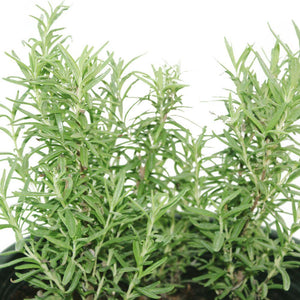
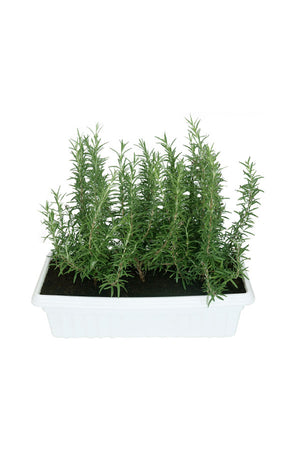
Shop: Rosemary - Salvia Rosmarinus - Shrub Plant, Rosemary - Salvia Rosmarinus - In Rectangular Pot
How often should you water rosemary in the UAE?
Water rosemary when the mix is dry at finger depth, not on a schedule. Push a finger into the mix up to the first knuckle: if it feels damp, wait and test again later. Then water thoroughly until water runs out of the drainage holes, and let the pot drain. NC State Extension says overwatering is the common cause of rosemary decline or death, and UF/IFAS says rosemary suffers when it is watered too often.
How fast rosemary mix dries depends on the pot, the spot and the season. Small pots, terracotta and full sun dry fastest; large plastic pots in shade stay damp longest. The University of Arizona Extension notes that pots in direct summer sun heat up and that small pots are very hard to keep moist, so in a UAE summer small pots in full sun dry out fastest of all. In the cooler months the mix dries slowly, so the test will tell you to water less often.
Water the soil, not the leaves. The University of Arizona Extension advises against watering the foliage of herbs, because it can cause sunburn and the minerals in the water can damage leaves. Rosemary is salt tolerant (NC State Extension), but if a white crust builds up on the mix or pot, flush the pot with plenty of water and let it drain.
- If the mix is still wet at the bottom of the pot, wait. Push a wooden skewer to the bottom to check deep pots.
- Empty any saucer once the pot stops dripping. Rosemary roots must never stand in water.
What soil and pot does rosemary need?
Rosemary needs a light, free-draining mix and a pot that lets extra water drain away. NC State Extension says rosemary grows in most soils except clay. For pots, the RHS advises a soil-based compost with horticultural grit (up to 25 per cent by volume), and the University of Arizona Extension says to add sand or perlite to a bought potting mix if it does not drain well.
Test a rosemary mix before you plant: dampen a handful and squeeze it. The University of Arizona Extension says that if it stays in a clump when you open your hand, it needs more sand or perlite; a good mix just falls apart.
Extra water must be able to leave a rosemary pot: the RHS says a rosemary pot needs plenty of drainage holes, and the University of Arizona Extension says herbs do not survive in soil that does not drain. If your rosemary sits in a pot without a hole, push a wooden skewer to the bottom before you water: if it comes out damp, wait.
For pot size, the RHS suggests a pot at least 30 cm wide and deep for rosemary, and the University of Arizona Extension recommends herb pots of at least about 35 cm (14 inches) in desert heat, because larger pots protect roots from extreme temperatures and dry out less quickly. Plastic pots hold more water and black plastic absorbs heat; clay pots let water evaporate and keep roots cooler but need more water. Raise rosemary pots off the ground so water drains and air reaches the base.
Shop: Perlite – Amorphous Volcanic Glass, Agro Organic Potting Soil – 50L
Should you fertilise rosemary?
Rosemary needs very little feeding. The RHS says rosemary in the ground does not need feeding, and that rosemary which has been in the same pot for more than a year benefits from a sprinkling of general-purpose granular feed in late spring or early summer. The University of Arizona Extension adds that herbs do not need heavy or frequent fertiliser, and that perennial herbs benefit from compost in spring. Always follow the dose on the package.
How do you prune and harvest rosemary?
Prune rosemary lightly every year after the flowers fade, and do not cut back into old, bare wood. The RHS says unpruned plants become leggy and bare at the base, and that rosemary does not usually recover from heavy pruning. NC State Extension says rosemary tolerates heavy pruning after flowering, so sources differ; a light trim is the safer choice. Regular picking is a form of pruning, and the University of Arizona Extension says pinching and trimming herbs encourages new, vigorous growth.
You can pick rosemary all year, because it is evergreen (RHS). The University of Arizona Extension advises cutting herbs in the early morning or evening, because the leaves hold less oil in the heat of the day.
- Use clean, sharp scissors or secateurs.
- Cut the soft, green tips of the stems: the RHS says the soft new growth has the best flavour.
- Take a little from all over the plant rather than a lot from one side, so it keeps a good shape.
- Stop where the stem turns brown and woody.
How do you propagate rosemary?
Rosemary is easiest to propagate from stem cuttings or by layering. NC State Extension says rosemary is slow to germinate from seed, and gardeners have more success with stem cuttings, layering or division. The RHS takes softwood cuttings from new growth and semi-ripe cuttings later in the season, and layers stems in spring or autumn.
Sources differ on how easy rosemary is to propagate. The RHS says rosemary is simple to grow from cuttings and NC State Extension says it roots easily, but UF/IFAS warns that rosemary can be difficult to start from seed or cuttings. Take a few more cuttings than you need, in case some fail.
Can rosemary grow indoors under AC?
Rosemary does not do well as a long-term indoor plant. It needs six or more hours of direct sun a day, and NC State Extension says rosemary can be difficult to keep indoors over winter, and that aphids, mealybugs, whiteflies and spider mites are pests to watch for, particularly indoors.
If you keep rosemary indoors for a while, give it the sunniest window you have, turn the pot often so each side gets light (Penn State Extension), keep it out of the direct stream of an AC vent, and water only when the mix tests dry. Move it outdoors gradually: the RHS advises starting plants that come out from indoors in bright shade, then giving them more direct sun step by step. In the hottest months, choose a spot with afternoon shade, not full summer sun.
Which rosemary plant should you choose?
Upright rosemary (for example 'Miss Jessopp's Upright')
Upright, bushy stems
Care: Same care. Trim after flowering to keep it compact.
Best for: Pots, herb gardens and low hedges
Trailing rosemary (for example 'Capri' or 'Prostratus')
Low, trailing stems that spill over edges
Care: Same care. With drip irrigation, place emitters where the spreading stems root.
Best for: Pot edges, walls and ground cover
What should you do in the first week after your rosemary plant arrives?
A new rosemary plant needs a sunny spot and a dry start. The main risk in the first week is too much water, not too little.
How does rosemary plant care change through the UAE year?
Summer May–Sep
Give rosemary morning sun and afternoon shade, or shade cloth. Test the mix more often in heatwaves, because small and terracotta pots dry fastest. Water the soil, not the leaves. Keep plants spaced for air flow, and do not plant or repot now.
Autumn Oct–Nov
The best time to plant, repot and take on new rosemary plants. Move plants back into full sun as the heat eases. The mix dries more slowly, so test before you water.
Winter Dec–Feb
Winter suits rosemary: full sun all day. Water less, because the mix dries slowly. Rosemary is frost-tolerant (hardy in USDA zones 8–10), so cold nights inland and in other GCC cities are rarely a problem; protect young plants only on rare frosty mountain nights. Make sure pots drain after rain, because cold, wet mix rots the roots.
Spring Mar–Apr
In warm climates rosemary often flowers in late winter and spring (UF/IFAS). Trim lightly after the flowers fade, and take cuttings from soft new growth. Give potted plants that have been in the same pot for over a year a sprinkling of general-purpose feed. Move pots to afternoon shade before May.
What are common rosemary plant problems and how do you fix them?
| What you see | Likely cause | First step |
|---|---|---|
| Brown, dry needles spreading from the base | Overwatering and root rot | Stop watering. Clemson Extension says too much water makes root rot more likely. |
| White powdery coating on the leaves | Powdery mildew | Cut off the worst affected shoots and throw them away (Clemson Extension: remove severely infected leaves). |
| Crispy, dry tips and needles in summer | Heat, full afternoon sun and a pot that dries out | Water thoroughly until water runs from the drainage holes. |
| Thin, spindly growth with small needles indoors | Too little direct sun | Move the plant outdoors gradually into direct sun, starting in bright shade (RHS), with afternoon shade from May to September. |
| Tiny insects, sticky leaves or fine webbing | Aphids, whiteflies, mealybugs or spider mites | If the plant is indoors, move it outdoors into the sun step by step. |
| Bare, woody stems with leaves only at the tips | No regular pruning, or age | Trim the green tips lightly after flowering each year to keep the plant bushy. |
Why is my rosemary turning brown and dying from the bottom up?
Rosemary that browns from the base while the mix is damp usually has root rot from too much water or poor drainage. NC State Extension calls overwatering the common cause of rosemary decline and lists root rot as a common disease, and the RHS says cold, wet compost can rot the roots.
How to tell: Mix that stays damp, brown needles that do not recover after watering, brown to black soft roots, a pot without drainage or standing in water.
How to fix it:
- Stop watering. Clemson Extension says too much water makes root rot more likely.
- Take the plant out of the pot and look at the roots. Clemson Extension says rotten roots are brown to black and may be soft.
- If only a few roots are rotten, cut them out with clean scissors and repot in fresh, gritty, free-draining mix (Clemson Extension).
- Water again only when the mix is dry at finger depth.
- If most roots are rotten, take cuttings from healthy green tips as a back-up.
What is the white powder on my rosemary leaves?
A white, powdery coating on rosemary leaves is powdery mildew, a fungal disease. NC State Extension says poor air circulation and high humidity cause it on rosemary, and UC IPM says shade and moderate temperatures favour it, while heat above about 35 °C (95 °F) can hold it back. Crowded plants and plants in shade or still air are most at risk.

How to tell: White or grey powder on the leaves and shoot tips, often on the shaded or crowded side of the plant.
How to fix it:
- Cut off the worst affected shoots and throw them away (Clemson Extension: remove severely infected leaves).
- Give the plant more space, air flow and direct sun. UC IPM says full sun and good air circulation help prevent powdery mildew.
- Do not overfeed: UC IPM says too much nitrogen gives soft, lush growth that favours the fungus.
- Water only when the mix is dry at finger depth (Clemson Extension: do not overwater).
Why is my rosemary drying out and turning crispy in summer?
Crispy rosemary in a UAE summer usually means the roots dried out in a small or hot pot, or the plant took full afternoon sun and hot wind. The University of Arizona Extension warns that pots in direct summer sun heat the roots and small pots are very hard to keep moist.
How to tell: Dry mix pulling away from the pot edge, crisp needles on the sunny side, a small or black plastic pot.
How to fix it:
- Water thoroughly until water runs from the drainage holes.
- Move the pot to morning sun and afternoon shade, or put up shade cloth.
- Repot into a larger pot in the cooler months if the plant dries out again and again.
- Trim off dead tips, but do not cut into old, bare wood.
Why is my indoor rosemary thin and spindly?
Thin, spindly rosemary indoors is not getting enough light. Rosemary needs six or more hours of direct sun a day, which a room away from a sunny window cannot give. Penn State Extension says herbs without the light they need grow thin and spindly, with smaller leaves.
How to tell: Long, thin stems that lean to the window, small needles, slow growth, sometimes white powder from mildew.
How to fix it:
- Move the plant outdoors gradually into direct sun, starting in bright shade (RHS), with afternoon shade from May to September.
- Until then, put it in the sunniest window you have, away from AC vents, and turn the pot often.
- Water less while it is indoors: the mix dries slowly there.
What are the tiny insects on my rosemary?
Rosemary is generally free of pests, but NC State Extension says to watch for aphids, mealybugs, whiteflies and spider mites, especially on plants kept indoors. UC IPM says fine webbing and leaves stippled with pale dots point to spider mites (tiny relatives of spiders), small white insects that fly up when disturbed are whiteflies, and white, waxy fluff is mealybugs.
How to tell: Small green or black insects on soft tips, white insects that fly up when you touch the plant, sticky leaves, fine webs.
How to fix it:
- If the plant is indoors, move it outdoors into the sun step by step.
- Rinse the pests off with a strong spray of water, on the undersides of the leaves too (UC IPM).
- If they come back, use an insecticidal soap and follow the label. The University of Arizona Extension advises against systemic insect controls on food plants.
- Check the label before you harvest after any treatment.
Why is my rosemary woody and bare at the bottom?
Rosemary turns woody and bare at the base when it is not trimmed. The RHS says unpruned rosemary becomes leggy, that you should not cut back into old wood, and that old, straggly plants are best replaced with new plants grown from cuttings.
How to tell: Long brown stems with green growth only at the ends.
How to fix it:
- Trim the green tips lightly after flowering each year to keep the plant bushy.
- Do not cut back into bare, brown wood.
- Take cuttings from the healthy green tips and replace a very old, straggly plant.
What mistakes kill a rosemary plant?
Watering on a fixed schedule
Do instead: Water only when the mix is dry at finger depth. The test gives a different answer in July and in January.
Keeping rosemary indoors under AC
Do instead: Grow it outdoors in direct sun. Indoors, only the sunniest window comes close.
A small pot in full summer sun
Do instead: Use a larger pot and give the plant afternoon shade from May to September.
Rosemary roots standing in water
Do instead: Use a pot with drainage holes (RHS) or test a pot without holes with a skewer, and empty the saucer once the pot stops dripping.
Watering over the leaves in hot sun
Do instead: Water the soil and keep the leaves dry.
Cutting back hard into old wood
Do instead: Trim the green growth lightly after flowering. The RHS says rosemary does not usually recover from heavy pruning.
Crowding rosemary between other pots
Do instead: Give it space so air can move around it. Still, humid air brings powdery mildew.
Rosemary Plant myths and facts
In the UAE heat, rosemary needs water every day.
Fact: No schedule fits every pot. The University of Arizona Extension says pots in a desert summer may need water up to twice a day, and that a pot which needs more is in too much sun or too small; in the cool months the same pot stays damp for much longer. Test the mix first: NC State Extension calls overwatering the common cause of rosemary decline.
Rosemary is an easy indoor herb.
Fact: Rosemary needs six or more hours of direct sun a day and is difficult to keep indoors. It grows best outdoors.
Rosemary cannot take UAE winter nights.
Fact: Rosemary is frost-tolerant and hardy in USDA zones 8–10. Wet roots in winter are a bigger risk than cold.
Is a rosemary plant safe for cats and dogs?
Yes. The ASPCA lists rosemary as non-toxic to dogs, cats and horses. Even a non-toxic plant can upset a pet's stomach if it eats a lot, so stop pets chewing it.
Which plants are similar to a rosemary plant?
| Plant | Light | Water | Pets | Choose it if |
|---|---|---|---|---|
| Thyme | Full sun | Dry, well-drained soil; drought-tolerant | Non-toxic to cats, dogs and horses (ASPCA) | You want a smaller herb with the same sun and dry-soil care |
| Sweet Basil | Full sun to partial shade | Moist, well-drained soil | Non-toxic to cats and dogs (ASPCA) | You want a fast, leafy kitchen herb and do not mind watering more often |
| Mint | Full sun; tolerates partial shade | Moist soil; does not do well in dry soil | Toxic to cats, dogs and horses (ASPCA) | Your balcony gets less sun, and you have no pets that chew plants |
Rosemary Plant FAQs
Can rosemary survive the UAE summer outdoors?
Yes, rosemary can survive the UAE summer outdoors if its roots do not cook or dry out. Give it a large pot that drains well, morning sun and afternoon shade or shade cloth, and test the mix more often in heatwaves. Water the soil, not the leaves.
When is the best time to plant rosemary in the UAE?
The best time to plant rosemary in the UAE is from October to November, at the start of the cooler gardening season. The University of Arizona Extension's herb calendar for the Tucson desert also gives October to November for rosemary. Planting in the cooler months lets the roots establish before the summer heat.
How big does a rosemary plant grow?
In the ground, rosemary can grow into a rounded shrub of about 1.2–1.5 m tall and 0.9–1.2 m wide (NC State Extension), and up to about 1.8 m tall and 1.2–1.5 m wide (UF/IFAS). In a pot, and with regular trimming, it stays much smaller (UF/IFAS).
Can rosemary grow near the sea in the UAE?
Yes. NC State Extension describes rosemary as highly salt and drought tolerant, so it suits coastal gardens and balconies. Give it full sun and good air flow, because still, humid air brings powdery mildew.
Does rosemary flower, and does it attract bees?
Yes, rosemary flowers. NC State Extension says the tiny flowers are blue, lavender or white (pink in some cultivars) and attract butterflies and bees. NC State gives spring into summer for flowering; UF/IFAS says rosemary in Florida's warm climate blooms in winter and spring.
Why is rosemary now called Salvia rosmarinus?
Botanists moved rosemary from the old genus Rosmarinus into Salvia, the sage genus, so its accepted name is now Salvia rosmarinus. Rosmarinus officinalis is the former name and is still common on labels. Both names mean the same plant, a member of the mint family (Lamiaceae).
Ordering from PlantsWorld
How is plant size measured?
Size is measured from the bottom of the nursery pot to the top tip of the highest leaf. A plant listed as 50-60 CM stands in that range measured this way.
Which pot option should I choose, nursery or decorative?
Choose the nursery pot for the lowest price or if you already have a planter. Choose a decorative pot for a ready-to-display plant that arrives fully potted with soil mix, perlite and a drainage layer. The plant itself is the same.
Do the decorative pots have drainage holes?
Decorative pot orders include a drainage layer at the base, with premium soil mix and perlite. For specific details on a particular pot model, send us the product link and our team will confirm.
Is the plant healthy on arrival? Can I check first?
Check your plant with the delivery agent: if it's damaged or not what you ordered, you can refuse it on the spot. If you find damage after unpacking, send photos and your order number on WhatsApp (+971 4 294 1422) or email sales@plantsworld.ae within 24 hours and we'll replace it free. You can also ask for a pre-dispatch photo.
Will my plant be safe in the UAE heat during delivery?
Yes. Our own delivery team brings your order, not a third-party courier. In extreme summer heat (June to September) we may move deliveries to farther emirates to a cooler day and agree the new day with you. If anything arrives damaged, we replace it free.
Do I need to repot my plant when it arrives?
Not immediately. Let it settle for a few weeks first, and note that a repotted plant can't be returned or replaced, so check it's healthy before you repot. Plants in decorative pots arrive fully potted. Repot only when roots fill the pot or growth stops.
Something looks wrong with your plant?
Send us photos on WhatsApp and our team will tell you what is happening and what to do. These five photos help us answer fast:
- The whole plant, from a step back
- A close-up of the problem leaf, front and back
- The soil surface and the pot, with the drainage hole if there is one
- Where the plant stands: the window, the AC vent and the light
- When you last watered, and how much
Buy a rosemary plant in Dubai and the UAE
More plant care guides
 Care guideAreca PalmAreca palm care in the UAE comes down to three things: bright indirect light away from harsh sun through glass, soil that stays moist but never soggy, and roots that never stand in water.Bamboo PalmCare guideBamboo PalmBamboo palm care in the UAE needs three things: bright indirect light with no direct sun, a free-draining mix kept slightly moist but never wet, and a spot out of the direct AC flow.
 Care guideGinseng Ficus BonsaiFicus ginseng care in the UAE comes down to steady conditions: give the bonsai plenty of bright light, water when the top part of the soil has dried, and keep it out of cold AC draughts.
 Care guideLucky BambooLucky bamboo (Dracaena sanderiana) is a tropical dracaena, not a true bamboo, that grows in water or soil.
 Care guidePeace LilyPeace lily care in the UAE comes down to three things: bright indirect light with no direct sun, soil that stays moist but never soggy, and a spot out of the airflow of AC vents.
 Care guideSnake PlantSnake plant care in the UAE is simple: give the plant bright indirect light, water only when the soil is dry to the bottom of the pot, and never let the roots stand in water.
 Care guideSpider PlantFor spider plant care in the UAE, give the plant medium to bright indirect light, out of direct sun and AC airflow, and water thoroughly when the top of the soil is dry.
 Care guideZZ PlantZZ plant care in the UAE is simple: keep the plant indoors in bright indirect light, away from direct sun through glass, and water only when the soil is completely dry to the bottom of the pot.
Sources
- Salvia rosmarinus (Rosemary), North Carolina Extension Gardener Plant Toolbox, NC State University
- How to grow rosemary, Royal Horticultural Society (RHS)
- Rosemary, UF/IFAS Gardening Solutions, University of Florida
- Growing Herbs in Tucson (AZ2061), Anne Lesenne, University of Arizona Cooperative Extension (2023)
- Growing Herbs Indoors, Penn State Extension
- Houseplant Diseases & Disorders, Clemson Cooperative Extension, Home & Garden Information Center
- Powdery Mildew on Ornamentals, UC Statewide IPM Program, University of California
- Spider Mites, UC Statewide IPM Program, University of California
- Aphids, UC Statewide IPM Program, University of California
- Moving houseplants outdoors, Royal Horticultural Society (RHS)
- Toxic and Non-toxic Plants: Rosemary, ASPCA Animal Poison Control
- Toxic and Non-toxic Plants: Basil, ASPCA Animal Poison Control
- Toxic and Non-toxic Plants: Mint, ASPCA Animal Poison Control
- Thymus vulgaris (Thyme), North Carolina Extension Gardener Plant Toolbox, NC State University
- Ocimum basilicum (Basil), North Carolina Extension Gardener Plant Toolbox, NC State University
- Mentha spicata (Spearmint), North Carolina Extension Gardener Plant Toolbox, NC State University
- Toxic and Non-toxic Plants: Thyme, ASPCA Animal Poison Control

