
How do you care for a ficus ginseng bonsai in the UAE?
 By Izzy Keethadath, Co-founder & Plant Specialist · Updated 15 November 2026
Ficus ginseng care in the UAE comes down to steady conditions: give the bonsai plenty of bright light, water when the top part of the soil has dried, and keep it out of cold AC draughts. This ficus bonsai (Ficus microcarpa 'Ginseng') drops leaves when it is moved, chilled, overwatered or left too dry.
Ginseng Ficus Bonsai quick facts
| Light | Lots of bright light, close to a window. Filter harsh summer afternoon sun through glass. |
|---|---|
| Water | When the top part of the soil feels dry. Never leave the pot standing in water. |
| Temperature | Most ficus prefer about 16–29 °C (University of Missouri Extension). Keep it away from cold draughts. |
| Humidity | Average indoor humidity is fine (University of Missouri Extension). High humidity is preferable and helps aerial roots form (NC State Extension). |
| AC tolerance | Good in an AC room, but cold air blowing on the leaves causes yellowing and leaf drop. |
| Outdoors in UAE | Possible in shade from October to April; bring it in on nights below about 16 °C. In summer a small bonsai pot dries out fast in the heat. |
| Pets | Toxic to cats and dogs if chewed (ASPCA genus entry, Ficus sp.). The milky sap can irritate skin. |
| Growth | Fast for a bonsai. Prune the shoots to keep the shape. |
| Main problem | Leaf drop after a move, a cold draught or a watering mistake. |
Is a ginseng ficus bonsai right for you?
A good fit if
- You want your first bonsai: NC State Extension calls the ginseng ficus easier to care for than other bonsai.
- You have a bright spot near a window in an AC home or office.
- You enjoy small, regular jobs such as pruning shoots and checking the soil.
- You want a desk or table plant with a sculptural trunk and roots.
Think twice if
- A cat or dog in your home chews plants: ficus is toxic if eaten.
- Your only space is a dim corner or a spot right under an AC vent.
- You travel often and cannot check a small pot that dries out quickly.
- You will be upset by some leaf drop when the plant moves to a new spot.
How much light does a ficus ginseng bonsai need?
A ficus ginseng bonsai needs plenty of light. University of Missouri Extension says the first key to a healthy indoor ficus is lots of light, from a good east-, west- or south-facing window or from plant lights. NC State Extension lists full sun to part shade for the species, Ficus microcarpa, and says to keep a ginseng ficus in a sunny, warm location.
A ficus ginseng in a dim room drops its leaves: UF/IFAS Extension lists low light as a cause of green leaf drop and says to move the plant to a brighter spot. Ficus is sensitive to sudden changes in light, so make any move to a much brighter or darker place gradually.
In the UAE, strong afternoon sun through west- or south-facing glass in summer can dry and shrivel ficus leaves. UF/IFAS lists too much sunlight as a cause of dry, shrivelled leaves. A sheer curtain filters that sun and keeps the light bright.
How often should you water a ficus ginseng bonsai?
Water a ficus ginseng bonsai when the top part of the soil has dried, not on a fixed day. Extension sources word this in two ways: NC State Extension says to keep a ginseng ficus consistently moist, and UF/IFAS Extension says the potting mix should be kept moist. University of Missouri Extension advises watering when the top 25 to 50 percent of the potting mix is dry to the touch, and warns that too much water suffocates the roots. Together they mean: keep the soil below the surface evenly moist, never soggy and never bone dry.
To test a ficus ginseng bonsai, push a finger or a wooden skewer into the soil. If the upper part is dry and the soil below is only just damp, water. If the soil is still wet near the surface, wait and test again later.
How fast ficus ginseng soil dries depends on the pot and the room. A small or shallow bonsai pot holds little soil and dries faster than a deep pot. A warm, bright window, inland heat and outdoor summer air dry the soil quickly; a dim AC room, a glazed pot and humid coastal weather keep it damp for longer. In the cooler months growth slows and the soil takes longer to dry.
When you water, water thoroughly until water runs out of the drainage hole, then empty the saucer or cover pot once it stops dripping. Both a soil that stays wet and a soil that dries out completely make a ficus drop leaves, so steady watering matters more than the amount.
- UF/IFAS lists moisture stress as a cause of yellow leaf drop. If leaves fall soon after the soil went bone dry or stayed soggy, adjust the watering first.
- If you see a white crust on the soil or pot, flush the pot with plenty of water to wash out the salts.
What soil and pot does a ficus ginseng bonsai need?
A ficus ginseng bonsai needs a potting mix that holds some water but drains well. UF/IFAS Extension says ficus needs a mix with good water-holding capacity and aeration, made from ingredients such as peat, pine bark and perlite. NC State Extension lists good drainage for the species.
Extra water must be able to leave the pot, because NC State Extension names overwatering as a cause of root rot in Ficus microcarpa. A pot with a drainage hole is the easiest way. If the bonsai sits in a decorative bowl or cover pot, empty any water that collects at the bottom after watering.
Shop: Universal Potting Soil – Holland, Perlite – Amorphous Volcanic Glass
Can a ficus ginseng bonsai live with AC in the UAE?
Yes, a ficus ginseng bonsai grows well in an air-conditioned UAE home or office, as long as cold air does not blow on it. University of Missouri Extension says most ficus prefer about 16–29 °C (60–85 °F), and that air noticeably warmer or cooler than the room causes leaf yellowing and leaf drop. UF/IFAS Extension says to avoid draughts.
To check a spot for a ficus bonsai, turn the AC on and hold your hand next to the leaves. If you feel the air moving, move the bonsai further away or turn the louvres away from it. Heaters and warm air from appliances cause the same problem.
Average indoor humidity is fine for a ficus, according to University of Missouri Extension. NC State Extension says high humidity (70–100%) is preferable for Ficus microcarpa and seems to favour the aerial roots that hang from its branches.
Should you fertilise a ficus ginseng bonsai?
Yes, a ficus ginseng bonsai benefits from feeding while it grows. University of Missouri Extension says ficus can be fed as little as once or twice a year or as often as the fertiliser label recommends, and that most gardeners stop in winter, when light levels fall and the days get shorter. In the UAE, pause feeding in the short days of winter and start again when new growth appears in spring.
Too much fertiliser builds up salts in a small bonsai pot. UF/IFAS Extension links high salts to loss of the oldest leaves, stunted growth and shrivelled roots, and advises less fertiliser, water with low salts and flushing the soil. Yellowing leaf edges point the other way, to underfeeding.
Shop: Naturwin Garden Organic Based All Purpose Indoor Plant Food Liquid Fertilizer (Blue)
How do you prune a ficus ginseng bonsai?
Prune a ficus ginseng bonsai by cutting back long shoots, thinning crowded branches and removing dead twigs, so that it keeps its shape. NC State Extension describes it as a fast grower, and UF/IFAS Extension says ficus usually needs pruning to keep its shape, to thin the foliage so light gets inside, and to remove dead branches.
Ficus has a milky sap (latex). NC State Extension says it can cause minor skin irritation, especially in sunlight, so wear gloves if your skin is sensitive and keep the sap away from pets.
- Use clean, sharp scissors or shears. UF/IFAS advises sterilised shears for removing dead twigs.
- Cut back long shoots that spoil the outline of the canopy.
- Thin crowded branches inside the canopy so light reaches the inner leaves.
- Remove dead twigs and any curled, folded leaves (a sign of thrips).
- Do not prune a new plant straight away. Let it settle in its new spot first.
When should you repot a ficus ginseng bonsai?
Repot a ficus ginseng bonsai when the roots fill the pot or water runs straight through. University of Missouri Extension says repotting every year or two gives the best growth under ideal conditions, and that ficus tolerates being root-bound but does not prefer it.
Do not repot a ficus ginseng in its first weeks at home. UF/IFAS Extension advises not to move, prune, repot or fertilise a ficus for at least about four weeks after it is placed indoors. In the UAE, most repotting is done in the cooler months, from October to April.
Keep the thick ginseng roots at the same height as before when you repot. The roots are the feature of a ficus ginseng, so do not bury them deeper in the new soil.
Can you propagate a ficus ginseng?
Yes. NC State Extension says Ficus microcarpa propagates easily from cuttings, either in water or directly in sand or potting soil.
Can a ficus ginseng bonsai live outside in the UAE?
A ficus ginseng bonsai can go outside in shade during the cooler months. NC State Extension lists Ficus microcarpa for full sun to part shade and for climates that stay warm all year, but a bonsai in a small pot has little soil and dries out quickly in UAE summer heat.
From May to September, keep an outdoor bonsai in shade and test the soil more often, or bring it indoors. Move it between an AC room and the outdoors gradually, because ficus reacts to sudden changes in light and temperature with leaf drop. In winter, bring an outdoor bonsai indoors on nights below about 16 °C: UF/IFAS Extension says to keep ficus above 60 °F (about 16 °C) at all times to avoid chilling injury, which shows as slimy dark spots and mass leaf drop. These nights are common inland (Al Ain, desert areas) and in colder GCC cities, and also happen on the coast in January.
Which ginseng ficus bonsai should you choose?
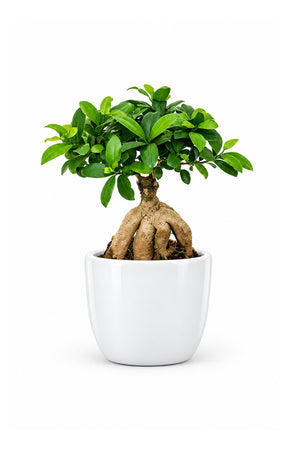
Ginseng ficus (single tree)
Thick, swollen roots above the soil, a short trunk and a canopy of glossy, teardrop-shaped leaves
Care: The care in this guide
Best for: Desks, shelves and first-time bonsai owners
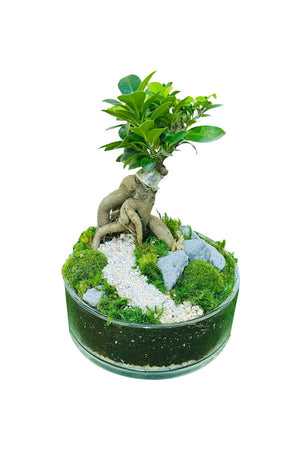
Grafted ginseng ficus
Ginseng roots with branches of a smaller-leaved ficus grafted on top
Care: Same care
Best for: A finer, more tree-like bonsai look
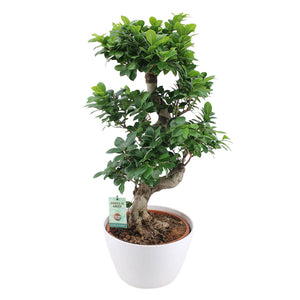
Larger ficus bonsai (S-shaped trunk)
A taller bonsai with a curved trunk and a dense, clipped canopy
Care: Same care. A bigger pot dries out more slowly than a small bonsai pot.
Best for: Living rooms, receptions and office tables
What should you do in the first week after your ginseng ficus bonsai arrives?
A ficus ginseng bonsai often drops some leaves after delivery as it adjusts to new light and temperature. The best help in the first weeks is a steady spot and careful watering.
How does ginseng ficus bonsai care change through the UAE year?
Summer May–Sep
Indoors under AC a ficus ginseng keeps growing: test the soil before you water and keep the bonsai out of cold air from vents and out of harsh afternoon sun through glass. Outdoor bonsai need shade, and small pots dry out fast in the heat, so test them more often or bring them in.
Autumn Oct–Nov
A good time to repot a root-bound ficus ginseng and to move bonsai back to shaded balconies (gradually). From November growth slows and the soil takes longer to dry.
Winter Dec–Feb
A ficus ginseng grows more slowly in winter: water only when the soil tests dry and stop feeding. Nights below about 16 °C (60 °F, the temperature UF/IFAS Extension says to keep ficus above) are common inland (Al Ain, desert areas) and in Riyadh or Kuwait, and also happen on the coast in January: bring outdoor bonsai indoors on cold nights. Make sure outdoor pots drain after rain.
Spring Mar–Apr
Start feeding a ficus ginseng bonsai again and prune long shoots to keep the shape. Spring is the second window for repotting. Move outdoor bonsai into shade before May.
What are common ginseng ficus bonsai problems and how do you fix them?
| What you see | Likely cause | First step |
|---|---|---|
| Green or yellow leaves falling | A move, a draught, cold, low light or a watering mistake | Keep the bonsai in one bright spot and stop moving it. |
| Yellow leaves, soil that stays wet | Overwatering and root rot | Stop watering and empty any water from the saucer or cover pot. |
| New leaves folded with purple or brown scars | Cuban laurel thrips | Move the bonsai away from other ficus plants. |
| White flecks on leaves, fine webbing | Spider mites | Wash the whole plant with a jet of water from a shower or kitchen sprayer, including the leaf undersides. |
| Sticky leaves, brown bumps or white cotton | Scale insects or mealybugs | Move the bonsai away from other plants. |
| Dry, shrivelled or crispy leaves | Too much sun or very low humidity | Move the bonsai out of harsh direct sun or filter it with a sheer curtain. |
Why is my ficus ginseng bonsai dropping leaves?
A ficus ginseng drops leaves when its conditions change or stress it. University of Missouri Extension names changes in its surroundings, cold and uneven watering, and UF/IFAS Extension adds soil that stays too wet and low light. Some leaf drop after delivery or a move is normal; it is a problem only if it continues.
How to tell: Leaves falling soon after a move, next to an AC vent or window, or after the soil stayed wet or went bone dry.
How to fix it:
- Keep the bonsai in one bright spot and stop moving it.
- Check for cold or warm air blowing on it, and move it out of the airflow.
- Test the soil: if it is wet, let it dry before you water again; if it is bone dry, water thoroughly.
- If the room is dim, move the plant gradually to a brighter place.
- Wait for new leaves. A ficus that keeps its new growth has settled.
Why are my ficus ginseng leaves turning yellow while the soil stays wet?
Yellow leaves on a ficus ginseng whose soil stays wet usually mean too much water. NC State Extension names overwatering as a cause of root rot in Ficus microcarpa, and University of Missouri Extension says too much water suffocates the roots.
How to tell: Soil still wet days after watering, water left in the bowl or cover pot, a sour smell, dark soft roots.
How to fix it:
- Stop watering and empty any water from the saucer or cover pot.
- Lift the bonsai out of its pot and look at the roots.
- Cut off black, soft roots with clean scissors.
- Repot in fresh, well-drained mix in a pot with a drainage hole.
- Water again only when the top part of the soil tests dry.
Why are the new leaves on my ficus ginseng curled, folded and spotted purple?
New leaves that curl and fold along the middle vein, with dark brown, reddish or purplish scars, are galls made by Cuban laurel thrips. University of California IPM says this thrips mainly attacks Ficus microcarpa. Small black insects and pale larvae live inside the folded leaves. The damage is mostly cosmetic, but heavy feeding can slow growth and make leaves fall early.

How to tell: Folded new leaves, purple or brown scars, tiny black insects inside the fold.
How to fix it:
- Move the bonsai away from other ficus plants.
- Cut off the curled, folded leaves and shoot tips and throw them away in a closed bag.
- Check new leaves as they open and remove any that fold.
- If the galls keep coming back, ask about a systemic insecticide labelled for thrips on houseplants. Sprays on the outside of the leaf do not reach thrips inside the galls.
What are the white specks and fine webs on my ficus ginseng?
Tiny white flecks on ficus leaves, sometimes with fine webbing, are a sign of spider mites. NC State Extension lists spider mites as a pest of Ficus microcarpa, and Colorado State University Extension says their feeding wounds appear as white flecks.
How to tell: Pale, speckled leaves; fine webs between leaves and stems; leaf drop in bad cases.
How to fix it:
- Wash the whole plant with a jet of water from a shower or kitchen sprayer, including the leaf undersides.
- Repeat the wash until no new flecks or webs appear.
- Raise the humidity around the plant: Colorado State University Extension names washing and higher humidity as the most effective controls.
- For a bad infestation, use a houseplant spray such as a neem-based product or horticultural oil, following the label.
Why are my ficus ginseng leaves sticky, with brown bumps or white fluff?
Sticky leaves with small brown bumps on the stems and leaf veins are a sign of scale insects; white, cottony clusters are mealybugs. NC State Extension lists both as pests of Ficus microcarpa. Both suck sap and leave a sticky honeydew on the leaves below.
How to tell: Brown or grey bumps that do not move, white fluff in leaf joints, sticky leaves, weak growth.
How to fix it:
- Move the bonsai away from other plants.
- Rub or pick off scale insects where there are only a few.
- Dab mealybugs with a cotton bud dipped in rubbing alcohol.
- Spray the plant with horticultural oil or a neem-based houseplant spray, following the label, and repeat as the label allows.
Why are my ficus ginseng leaves dry and shrivelled?
Dry, shrivelled leaves on a ficus ginseng come from too much sunlight or very low humidity, according to UF/IFAS Extension. In the UAE this can happen when a bonsai sits in afternoon sun behind glass or outdoors in summer without shade.
How to tell: Dry, crisp leaves on the side facing the sun, often after a move to a sunnier spot.
How to fix it:
- Move the bonsai out of harsh direct sun or filter it with a sheer curtain.
- Check that the soil is not drying out completely between waterings.
- Keep it away from hot or cold air from vents and appliances.
- The damaged leaves will not recover. Remove them and wait for new growth.
What mistakes kill a ginseng ficus bonsai?
Watering on a fixed weekly schedule
Do instead: Water when the top part of the soil is dry. Test it with a finger or a skewer before each watering.
Water left standing in the bonsai bowl, saucer or cover pot
Do instead: Water until it drains, then empty the saucer or cover pot once the pot stops dripping.
A spot right under or in front of an AC vent
Do instead: Keep the bonsai out of the airflow. With the AC on, hold your hand next to the leaves: if you feel moving air, move the plant or turn the louvres away.
Moving the bonsai again and again to find the right spot
Do instead: Choose one bright spot and leave the plant there. Every move can cause new leaf drop.
Repotting, pruning and feeding a new bonsai straight away
Do instead: Let it settle first. UF/IFAS Extension advises waiting at least about four weeks after a ficus is placed indoors.
Burying the thick ginseng roots when you repot
Do instead: Keep the roots at the same height as before. They are the feature of the plant.
A dim corner far from any window
Do instead: Bright light near a window, or a plant light. Low light causes leaf drop.
Ginseng Ficus Bonsai myths and facts
A ficus ginseng is a ginseng plant.
Fact: A ficus ginseng is a fig, Ficus microcarpa. It gets its name from its thick, swollen roots, which look like ginseng roots.
Leaf drop means the bonsai is dying.
Fact: Ficus often drops leaves after a move or a change in conditions. University of Missouri Extension says this is not necessarily a problem unless it continues over time.
A bonsai must live outdoors.
Fact: UF/IFAS Extension says Ficus microcarpa is grown as a tree outdoors in the tropics but is commonly used as a bonsai indoors. A ficus ginseng does well indoors in bright light.
A bonsai on your desk cleans the air in the room.
Fact: A 2019 review of chamber studies found that a building would need 10 to 1,000 potted plants per square metre of floor to match the air exchange it already has. Keep a bonsai because you enjoy it, not as an air cleaner.
Is a ginseng ficus bonsai safe for cats and dogs?
No, a ficus ginseng bonsai is not pet-safe. The ASPCA has no separate entry for Ficus microcarpa, but its genus entry for fig plants (Weeping Fig, Ficus sp.) is toxic to cats, dogs and horses, with the toxic principles ficin and ficusin. For weeping fig (Ficus benjamina), the ASPCA lists stomach and skin irritation as the signs, and Clemson Extension says all parts are irritating, especially the white, milky sap. Keep the bonsai out of reach of pets and young children.
Which plants are similar to a ginseng ficus bonsai?
| Plant | Light | Water | Pets | Choose it if |
|---|---|---|---|---|
| Money Tree | Indirect light or a mix of sun and shade | Moist but well-drained; never soggy | Non-toxic (ASPCA) | You have pets and want a small tree with a braided trunk |
| Umbrella Plant | Bright, filtered light | Let the soil dry, then soak | Toxic if chewed (ASPCA) | You want a bushy, tree-like plant with larger leaves |
| Rubber Plant | Bright indirect light, no afternoon sun | Fairly dry between waterings | Toxic if chewed (ASPCA lists ficus) | You want a ficus with large, bold leaves instead of a bonsai |
| Hobbit Jade | Sunny, with some afternoon shade | Only when the soil is dry | Toxic if chewed (ASPCA) | You want a small, tree-like desk plant that needs less water |
Ginseng Ficus Bonsai FAQs
Is a ficus ginseng the same as Ficus retusa?
Ginseng ficus is often sold labelled Ficus retusa, but NC State Extension says that is a common mislabel: the ginseng ficus is a cultivar of Ficus microcarpa, and the name Ficus retusa belongs to another plant. So a ginseng bonsai labelled 'Ficus retusa' is still a Ficus microcarpa and follows the advice in this guide.
Is a ficus ginseng a good bonsai for beginners?
Yes. NC State Extension says the ginseng ficus grows somewhat faster and is easier to care for than other bonsai species, which makes it a good first bonsai. It needs bright light, steady watering and a spot out of draughts more than special bonsai skills.
Does a ficus ginseng clean the air?
A ficus ginseng does not noticeably clean the air in a normal room. A 2019 review of chamber studies (Cummings and Waring) found that a building would need 10 to 1,000 potted plants per square metre of floor to match the air exchange it already gets from ventilation.
Why is it called a ginseng ficus?
A ginseng ficus is named after its thick, bulbous roots, which look like ginseng roots. NC State Extension says these exposed roots are the reason the cultivar is used so widely for bonsai. It is a fig, not a ginseng plant.
Why does my ficus ginseng grow thin roots from its branches?
Thin roots that hang from the branches are aerial roots, which are normal for Ficus microcarpa. NC State Extension says high humidity favours them. You can leave them or remove them: University of Missouri Extension says unwanted aerial roots can be removed without harming the plant.
How big does a ficus ginseng bonsai get?
A ficus ginseng bonsai stays small because it grows in a small pot and is pruned regularly. The same species, Ficus microcarpa, grows into a large tree in warm climates: NC State Extension says it can reach about 12 m (40 ft) outdoors in Mediterranean climates.
Is the sap of a ficus ginseng harmful to people?
The white, milky sap (latex) of a ficus can irritate the skin. NC State Extension says ficus latex can cause minor skin irritation, especially in sunlight. Wear gloves when you prune if your skin is sensitive, wash your hands afterwards, and keep the plant away from young children who might chew it.
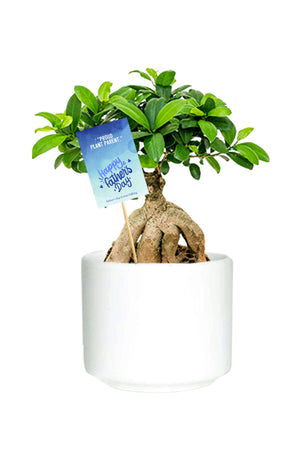
Is a ficus ginseng bonsai a good gift?
A ficus ginseng bonsai suits people who have a bright window and enjoy small care jobs such as pruning. Tell the person that some leaf drop in the first weeks is normal, and that the plant is toxic to cats and dogs.
Ordering from PlantsWorld
My plant arrived with a few drooping or yellow leaves. Is that normal?
Yes, that's normal. A few drooping, bent or yellow leaves are a common reaction to the journey and a new spot, and plants usually recover within a few days. Keep it in bright indirect light and check the soil before watering. If the plant or pot is actually damaged, send photos within 24 hours.
Will my plant look exactly like the website photo?
You'll receive the variety and size you ordered, but every plant grows individually, so leaf count, shape and shade can differ from the photo, which is representative. For peace of mind, ask for a pre-dispatch photo at checkout or on WhatsApp.
Do the decorative pots have drainage holes?
Decorative pot orders include a drainage layer at the base, with premium soil mix and perlite. For specific details on a particular pot model, send us the product link and our team will confirm.
Which pot option should I choose, nursery or decorative?
Choose the nursery pot for the lowest price or if you already have a planter. Choose a decorative pot for a ready-to-display plant that arrives fully potted with soil mix, perlite and a drainage layer. The plant itself is the same.
Is the plant healthy on arrival? Can I check first?
Check your plant with the delivery agent: if it's damaged or not what you ordered, you can refuse it on the spot. If you find damage after unpacking, send photos and your order number on WhatsApp (+971 4 294 1422) or email sales@plantsworld.ae within 24 hours and we'll replace it free. You can also ask for a pre-dispatch photo.
Do I need to repot my plant when it arrives?
Not immediately. Let it settle for a few weeks first, and note that a repotted plant can't be returned or replaced, so check it's healthy before you repot. Plants in decorative pots arrive fully potted. Repot only when roots fill the pot or growth stops.
Can I send a plant as a gift to someone?
Yes. Enter the recipient's address and phone number at checkout. Decorative pot options arrive fully potted, ready to display. Gift orders can't be returned or cancelled for change of mind, but if a gift arrives damaged we replace it free.
Something looks wrong with your plant?
Send us photos on WhatsApp and our team will tell you what is happening and what to do. These five photos help us answer fast:
- The whole plant, from a step back
- A close-up of the problem leaf, front and back
- The soil surface and the pot, with the drainage hole if there is one
- Where the plant stands: the window, the AC vent and the light
- When you last watered, and how much
Buy a ginseng ficus bonsai in Dubai and the UAE


More plant care guides
 Care guideAreca PalmAreca palm care in the UAE comes down to three things: bright indirect light away from harsh sun through glass, soil that stays moist but never soggy, and roots that never stand in water.Bamboo PalmCare guideBamboo PalmBamboo palm care in the UAE needs three things: bright indirect light with no direct sun, a free-draining mix kept slightly moist but never wet, and a spot out of the direct AC flow.
 Care guideLucky BambooLucky bamboo (Dracaena sanderiana) is a tropical dracaena, not a true bamboo, that grows in water or soil.
 Care guidePeace LilyPeace lily care in the UAE comes down to three things: bright indirect light with no direct sun, soil that stays moist but never soggy, and a spot out of the airflow of AC vents.
 Care guideRosemary PlantRosemary plant care in the UAE comes down to sun, drainage and careful watering.
 Care guideSnake PlantSnake plant care in the UAE is simple: give the plant bright indirect light, water only when the soil is dry to the bottom of the pot, and never let the roots stand in water.
 Care guideSpider PlantFor spider plant care in the UAE, give the plant medium to bright indirect light, out of direct sun and AC airflow, and water thoroughly when the top of the soil is dry.
 Care guideZZ PlantZZ plant care in the UAE is simple: keep the plant indoors in bright indirect light, away from direct sun through glass, and water only when the soil is completely dry to the bottom of the pot.
Sources
- Ficus microcarpa (Chinese Banyan, Indian Laurel), North Carolina Extension Gardener Plant Toolbox, NC State University
- Ficus microcarpa 'Ginseng' (Ficus Ginseng), North Carolina Extension Gardener Plant Toolbox, NC State University
- Ficus (Fig), North Carolina Extension Gardener Plant Toolbox, NC State University
- Ficus: 2026 Houseplant of the Year, David Trinklein, University of Missouri Extension (Missouri Environment and Garden), 2026
- Cultural Guidelines for Commercial Production of Interiorscape Ficus (ENH879), Chen, McConnell, Henny and Everitt, UF/IFAS Extension
- Cuban Laurel Thrips, University of California Statewide IPM Program
- Managing Houseplant Pests, Colorado State University Extension
- Toxic and Non-toxic Plants: Weeping Fig (Ficus sp.), ASPCA Animal Poison Control
- Pet Owners Beware: 11 Poisonous Houseplants to Avoid, Clemson Cooperative Extension, Home & Garden Information Center
- Potted plants do not improve indoor air quality: a review and analysis of reported VOC removal efficiencies, Cummings & Waring, Journal of Exposure Science & Environmental Epidemiology (2019)

